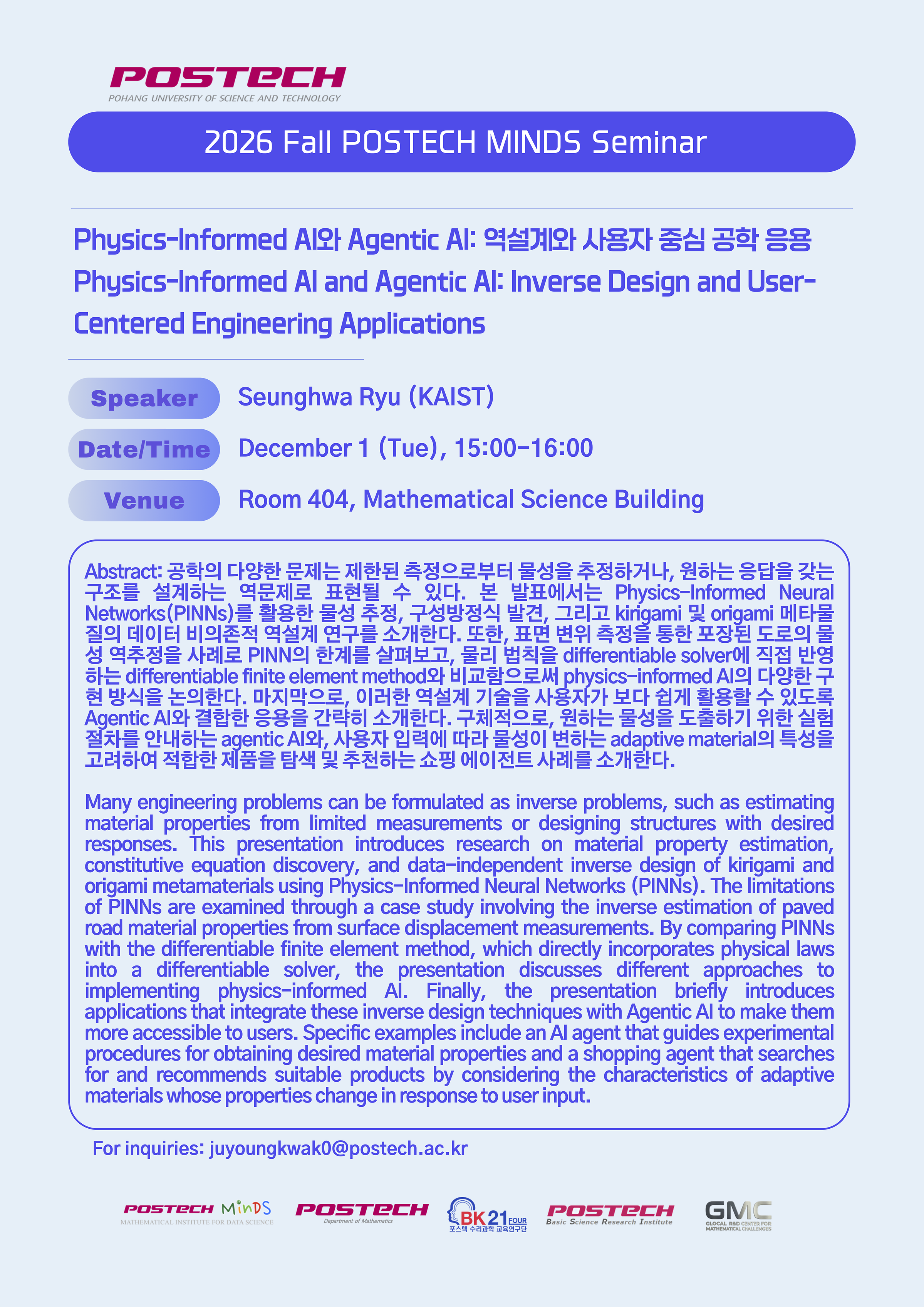
| Contents | Many engineering problems can be formulated as inverse problems, such as estimating material properties from limited measurements or designing structures with desired responses. This presentation introduces research on material property estimation, constitutive equation discovery, and data-independent inverse design of kirigami and origami metamaterials using Physics-Informed Neural Networks (PINNs). The limitations of PINNs are examined through a case study involving the inverse estimation of paved road material properties from surface displacement measurements. By comparing PINNs with the differentiable finite element method, which directly incorporates physical laws into a differentiable solver, the presentation discusses different approaches to implementing physics-informed AI. Finally, the presentation briefly introduces applications that integrate these inverse design techniques with Agentic AI to make them more accessible to users. Specific examples include an AI agent that guides experimental procedures for obtaining desired material properties and a shopping agent that searches for and recommends suitable products by considering the characteristics of adaptive materials whose properties change in response to user input.
공학의 다양한 문제는 제한된 측정으로부터 물성을 추정하거나, 원하는 응답을 갖는 구조를 설계하는 역문제로 표현될 수 있다. 본 발표에서는 Physics-Informed Neural Networks(PINNs)를 활용한 물성 추정, 구성방정식 발견, 그리고 kirigami 및 origami 메타물질의 데이터 비의존적 역설계 연구를 소개한다. 또한, 표면 변위 측정을 통한 포장된 도로의 물성 역추정을 사례로 PINN의 한계를 살펴보고, 물리 법칙을 differentiable solver에 직접 반영하는 differentiable finite element method와 비교함으로써 physics-informed AI의 다양한 구현 방식을 논의한다. 마지막으로, 이러한 역설계 기술을 사용자가 보다 쉽게 활용할 수 있도록 Agentic AI와 결합한 응용을 간략히 소개한다. 구체적으로, 원하는 물성을 도출하기 위한 실험 절차를 안내하는 agentic AI와, 사용자 입력에 따라 물성이 변하는 adaptive material의 특성을 고려하여 적합한 제품을 탐색 및 추천하는 쇼핑 에이전트 사례를 소개한다.
|